
Last spring, a junior we'll call Noah reached out three weeks before his AP exams. Between track and the rest of his homework, he had trouble finding time for tutoring. He fit in two sessions and came away frustrated by how far behind he was.
Noah is a very capable kid. An hour a week starting in the fall would have spared him that discouragement, and he would have walked into his exams prepared.
His situation is a common one. Every spring, families call us with some version of "The AP exam is a month away. Can you help?" We always step in. But the real advantage comes when you start much earlier.
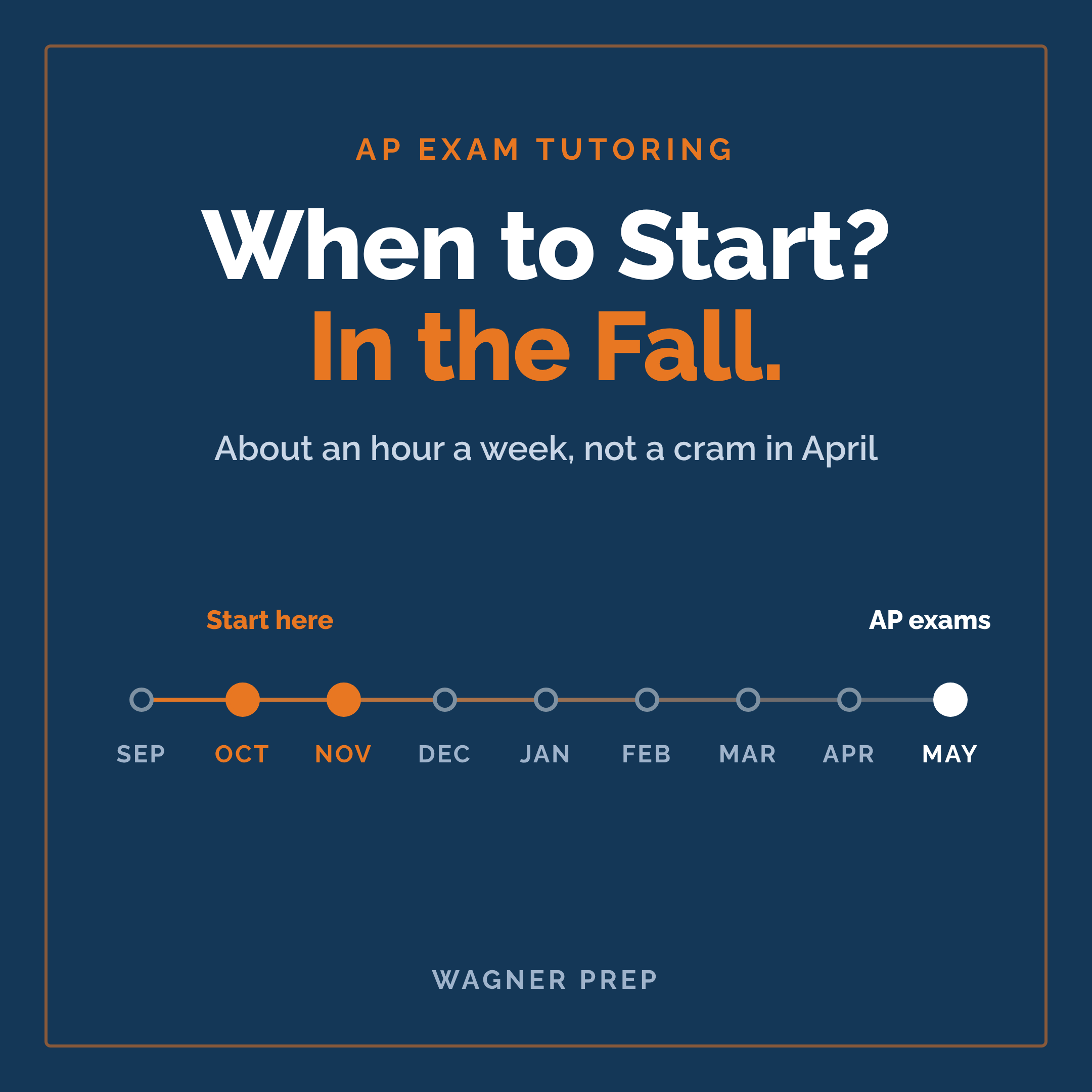
So when should your student start AP exam tutoring? In the fall, ideally by October or November, with about an hour a week. That's enough to keep pace with the class and catch gaps before they pile up in the spring.
Why starting AP tutoring in April is too late
AP exams cover a full year of material, and the units build on each other. A free-response question in May can depend on something from September that a student skimmed and moved past. These are skills that get built over time. AP exams aren't tests you cram for.
Students who are doing well in the class feel a version of this too. AP courses are packed with detail, and strong students often try to learn every piece of it with the same intensity. That is exhausting and unnecessary. Not every detail deserves the same attention.
The scores matter, too. Since SAT Subject Tests were discontinued in 2021, AP scores are one of the few ways a student can show mastery in a specific subject. Junior-year scores can go on college applications, and high scores can earn credit or placement once a student gets to college. Learn more about how colleges weigh the rigor of your student's secondary school record.
How weekly AP tutoring works during the school year
We see the best results when a student works with us throughout their course. Weekly sessions keep pace with the class, so gaps get caught in October instead of April. A tutor who knows the exam can also help a student focus on what's most likely to show up, instead of getting stuck in the details. That makes the whole year less stressful.
If you're reading this in March or April, it isn't too late. We can still help in a shorter window when a student can commit the time. Steady work over the year is just where we see students do their best with the least amount of stress.
How one student earned a 5 on AP Calculus BC
Sophie started with us in November of her senior year. She was doing fine in AP Calculus BC, but it was taking up so much of her time that it had become overwhelming. She wasn’t sure which content to focus on or how much studying was “enough.”
In her first session, she worked through her class packet on integrals without much trouble. Then her tutor switched to AP-style multiple-choice questions on concepts like the Mean Value Theorem, and those were harder for her. Knowing the math and answering questions the way the AP exam asks them turned out to be two different skills.
That became the plan. Most weeks, they worked through whatever her class was covering, then tried AP-style questions on the same topic. Her tutor would take a problem from her packet, change the numbers, and have her solve it again. They worked through past free-response questions. When her class had a test coming up, they focused on that instead. The goal was to keep up all year so nothing piled up in the spring.
By spring, the math wasn't the problem. Sophie usually got the right answer but didn't trust it, and oddly worded questions could still throw her off. Her tutor kept coming back to two things: trust your work, and slow down on the questions that seem designed to trip you up. They spent extra time on limits, continuity, and differentiability, the topics that gave her the most trouble.
In the weeks before the exam, they did three full practice tests. In their last session, they started with a review packet from her teacher that was harder than anything on the actual AP exam, and it rattled her. So they switched to an official College Board practice exam, and she worked through it easily.
That was about 15 hours of tutoring over the year. Sophie walked into the exam knowing the format and earned a 5. The score also let her skip the math placement test at her college and get into more advanced courses for her major.
2027 AP exam dates and the digital Bluebook format
Every AP exam is now taken in Bluebook, the same College Board app students use for the digital SAT. How much happens on screen depends on the subject.
Fully digital exams, like AP US History, AP English Language, AP Psychology, and AP Environmental Science, happen entirely in Bluebook, free-response section included.
Hybrid exams include AP Calculus AB and BC, AP Biology, AP Chemistry, the AP Physics exams, and AP Precalculus. Students see the multiple-choice questions and the free-response prompts on screen, but they still write their free-response answers by hand in a paper booklet.
A few subjects changed this year. AP Statistics moved from hybrid to fully digital. The world language exams are now fully digital, listening and speaking included. AP Music Theory is now hybrid.
Students can try a test preview in Bluebook to get used to the tools before exam day. College Board lists which exams fall into which group on its exam modes page.
Most of the AP process runs through your student's school and their College Board account. These are the dates families tend to miss:
Early fall: Your student joins their AP class section in My AP with a join code from their teacher. Make sure the class shows up in their College Board account, since that's how many schools handle exam registration.
September to November: Exam registration. Your school's AP coordinator sets a November deadline for ordering exams, so check that date with the school.
By December: If your student needs testing accommodations, like extended time, contact your school's SSD coordinator now. The school submits the request, and College Board's deadline is January 22, 2027.
May 3 to 7 and May 10 to 14, 2027: AP exams.
June 20, 2027: Deadline to choose the college that gets your student's free score report.
July 2027: Scores come out.
Since we get asked this a lot: Wagner Prep isn't affiliated with College Board, so registration and accommodations go through your school. If you're not sure who to contact, we're happy to help you figure it out.
You can find the full timeline on College Board's AP exam calendar. College Board also has a credit policy search where you can look up how specific colleges award AP credit.
AP tutoring with Wagner Prep
We work one-on-one with AP students in NYC and online. If your student is taking APs this year, book a consultation and we'll talk through where they are and what makes sense. That might be weekly sessions starting now, or a shorter push closer to May. We can work with either, though the students who start in the fall usually have the easier spring.
Frequently asked questions
-
In the fall, ideally by October or November. Starting early lets weekly sessions keep pace with the class, so gaps get fixed before they stack up in the spring.
-
It depends on the student and the subject. Sophie, the AP Calculus BC student above, did about 15 hours spread over the school year and earned a 5. Students who are struggling in the class usually need more.
-
Yes. Every AP exam is now taken in the Bluebook app. Some are fully digital, and some are hybrid, meaning students read the questions on screen but handwrite their free-response answers in a paper booklet.
Sophie and Noah are composites based on students we've worked with. Names and details have been changed.
