
How Colleges Evaluate Academic Rigor and Why AP Access Matters
Every accredited college in the United States publishes something called the Common Data Set. Inside that report, each college must indicate what matters most in admissions. It is not easy to find, and most families never know to look at it, but it does hold the answers to many admissions questions.
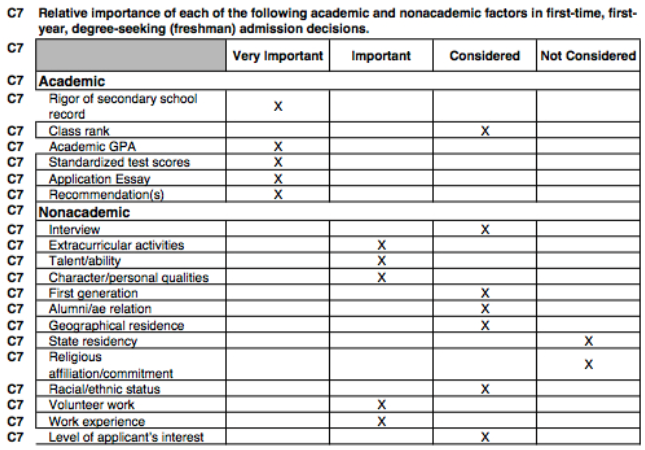
In Section C7, schools rank factors like GPA, standardized test scores, essays, extracurricular activities, and one category that often surprises families:
Rigor of secondary school record.
At many selective colleges, rigor is marked as Very Important.
Not optional. Not secondary. Not a bonus. Very Important.
That designation carries real weight in how applications are reviewed.
Below is one example. You’ll see how Northeastern University evaluates key admissions factors. As with many selective institutions, academic rigor sits at the top of the list, alongside GPA and standardized test scores.
What “Academic Rigor” Actually Means
When admissions officers talk about rigor, they're asking: did this student take the hardest courses available to them, or play it safe?
Admissions officers do not evaluate transcripts in a vacuum. They receive a school profile with every application. They know:
Which AP courses are offered
Which honors tracks are available
Whether dual enrollment exists
What the typical student at that school takes
They are trained to read transcripts in context.
A 3.9 GPA with limited rigor will be evaluated differently than a 3.8 GPA with sustained AP and honors coursework. Colleges are not simply counting grades. They are assessing preparation and openness to challenge.
Here is the part many families do not realize:
Access to rigorous courses is often earned earlier than junior year.
The Sophomore Reality
We recently spoke with the family of a sophomore at a competitive high school. He is academically strong and interested in pursuing law. But at his school, students must earn a 95 or above in Honors English to qualify for AP English junior year.
A 90 is not enough. Even if the student understands the material, the cutoff is firm.
The good news is that he still has time to raise his average and meet the threshold. But without this conversation, his parents would not have realized how important that specific benchmark was. In their minds, a 90 meant he was doing well and staying on track.
Sophomore year grades can determine which advanced courses a student can access junior year. And junior year is the final full year of completed grades colleges evaluate. Admissions officers are not simply reviewing individual classes. They are evaluating the story a transcript tells about challenge, consistency, and momentum over time.
By the end of junior year, that academic trajectory is largely established. Senior year courses appear on the application, but the pattern of rigor across three years is already visible.
That is why sophomore year planning carries more weight than many families realize.
Academic Support Is Not Just for Struggling Students
In the case of the sophomore we met, the student was earning around a 90 in Honors English. He understood the material. But at his school, that grade would not qualify him for AP English.
Raising a 90 to a 95 was not about remediation. It was about preserving access to advanced coursework.
That difference can meaningfully shape how colleges view a transcript.
Academic momentum compounds. A student who qualifies for AP English junior year may continue into AP Literature senior year. A student who misses out on qualifying for Precalc Honors may be ineligible for AP Calc, derailing his admissions into competitive engineering programs.
The Conversation Families Should Be Having Now
If you have a freshman or sophomore, this is the time to get clear on your school’s academic expectations and eligibility rules. Set up a meeting with your school counselor and ask:
What grade thresholds determine AP eligibility at our school?
Which courses require teacher recommendations?
What math or language sequences are required to reach upper-level APs?
Are there automatic cutoffs, or is there an appeal process?
How does our school profile describe course rigor to colleges?
What does a “most rigorous” track typically look like here?
Academic rigor is one of the few admissions factors students can influence early in high school.
But rigor does not mean taking every AP course available.
Colleges are not awarding points for sheer volume. They are evaluating whether a student pursued a meaningful challenge within their strengths and academic direction.
A student interested in law or the humanities does not need to overload their schedule with the most advanced STEM coursework if it comes at the expense of GPA. Likewise, a future engineering student should prioritize math and science progression over stacking unrelated APs.
The right question is not “How many APs should my student take?”
It is “Which advanced courses make sense for my student, and how can they succeed in them?”
That balance of challenge, alignment, and sustainability is what strengthens an application.
At Wagner Prep, we help families map academic trajectories that align with a student’s strengths and long-term college goals. Thoughtful planning early in high school ensures that academic rigor — one of the most important factors in college admissions — is maximized over time, not left to chance.
But planning is only one piece.
We also support students directly in their coursework. Our subject-area tutors work with students in AP, IB, honors, and other classes to strengthen performance where it matters most.
Sometimes the goal is not to “catch up.” It is to move from a 90 to a 95. To preserve eligibility for AP Language. To stay on track for AP Calculus. To maintain access to the most rigorous pathway available at a student’s school.
That kind of academic support is not remediation. It is strategy.
Choosing to invest in targeted subject tutoring early can protect opportunity later.
If you would like help mapping your student’s academic plan or strengthening performance in a specific course, we would be glad to talk. Schedule a consultation to build a plan that supports both academic success and long-term admissions goals.