
A guide for families with students in 9th through 12th grade
At some point in almost every family's college journey, there is a moment where someone says: why didn't anyone tell us this sooner?
Sometimes it is a junior who just found out all of their friends took the SAT in the fall and they have not started studying. Sometimes it is a senior realizing in October that the essay they put off all summer is now due in two weeks. Sometimes it is a parent of a sophomore wondering whether they are already behind.
At Wagner Prep, we break the college process into three phases: Explore, Evaluate, and Execute. Each phase has its own set of priorities, and knowing which one your student is in changes everything about how you approach the process. It is also never too late to get started. The best time was yesterday. The next best time is today.
What follows is a grade-by-grade breakdown of what families need to focus on when, and what they can stop worrying about until the time is right.
Freshmen and Sophomores
Freshman year
If your student is in 9th grade, the single most important thing you can do is resist the urge to make decisions too early. This is not the time to brand your student, pick a major, or map out a college list. It is the time to build the foundation that makes all of those decisions easier later.
Freshman year is for exploring. Try the debate club, join a sport, take an elective that sounds interesting, volunteer somewhere new. You do not need to know yet which activity will become important. What you are looking for at this stage are clues: what does your student talk about without being asked? What do they put effort into without being pushed? Those patterns matter more than any decision you could make right now.
One thing worth knowing early: colleges are not looking for well-rounded students. They are looking for students who went deep on something. A student who spent three years seriously pursuing one or two real interests is more compelling than a student who joined eight clubs to pad a resume. That depth, what we call being "spiky," starts forming in ninth grade.
Sophomore year
By sophomore year, it is time to start making choices. If your student has discovered a genuine interest in robotics, a sport they love, or a creative pursuit that keeps pulling them back, that is where the energy should go. The goal is not to quit everything else overnight, but to begin investing more deliberately in the things that actually light your student up.
This is also the year to get intentional about course selection. Most high schools have prerequisites for AP and honors classes in junior and senior year, and the path to those courses runs directly through sophomore grades. If your student has ambitions around rigorous coursework later, the planning starts now. Read more about how course rigor is evaluated by colleges here.
Spending summers intentionally during these years pays off more than most families expect. A study abroad program, a volunteer opportunity, a summer job, or an internship connected to a growing interest are all ways your student can deepen what they are already exploring and gain experience that will actually be worth writing about. Students who arrive at junior year with a few meaningful experiences behind them are almost always better positioned, both on paper and in the room.
What about testing and college visits?
Most freshmen and many sophomores are not ready to start SAT or ACT prep yet. The majority of the math section covers Algebra 2 concepts, and without that foundation in place, students end up spending more time learning content than test strategy. The reading and writing section has its own learning curve too. Students who have not yet built the habit of reading complex, dense text regularly tend to struggle with pacing and comprehension in ways that take time to develop.
Starting too early also tends to burn students out. A student who has been preparing for an exam for over a year by the time they sit down to take it has usually lost the focus and motivation that makes prep effective. We recommend hitting the sweet spot: after the bulk of Algebra 2 is complete, before the schedule fills up with other commitments. More on how to find that window in the junior section below.
College visits, on the other hand, are never too early. The goal at this stage is not to find the school. It is to help your student build a picture of what college life actually looks and feels like. One or two visits to very different types of campuses can do a lot of quiet work, long before the real list-building begins.
Rising Juniors
Junior year is when the college process shifts from background noise to intentional conversations and action taking. This is the year to map out a testing plan, get serious about course rigor, start visiting campuses, and begin forming a picture of what your student actually wants in a college. None of that needs to be finalized by June. But it all needs to start.
Choosing your testing lane
We recommend planning for three official test dates whenever possible. Taking the test more than once gives students a chance to apply what they have learned, shake off first-attempt nerves, and maximize their superscore.
How you sequence those three attempts depends on your student's schedule, math level, and reading habits. A student with a packed spring full of AP exams looks different from a student with a lighter second semester. A student who has already completed Algebra 2 has more flexibility to start earlier. There is no single right path, but there is one that fits your family, and mapping it out in the fall of junior year is the right time to do it.
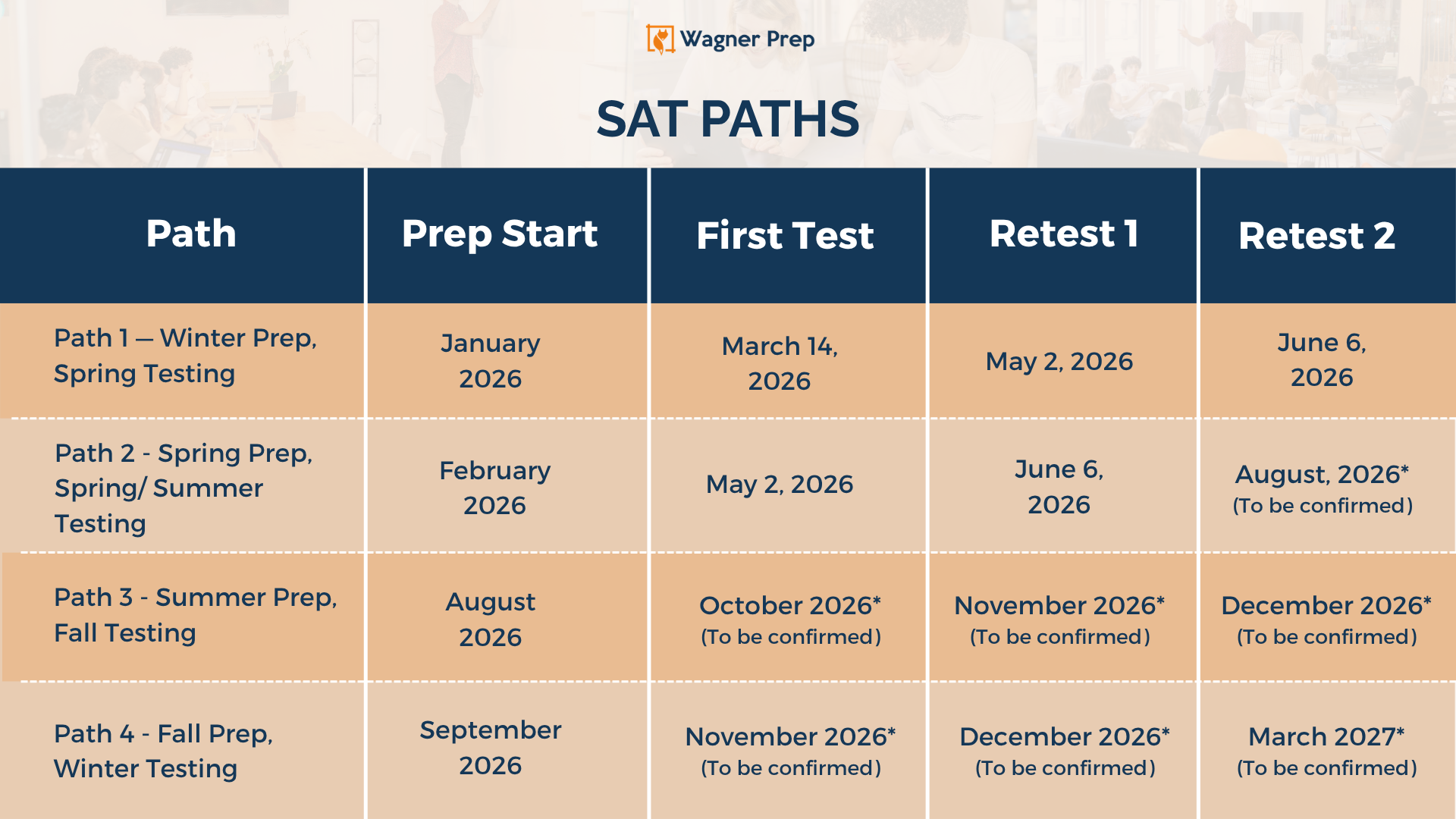
Download the full SAT Paths infographic to keep on hands as you plan testing timeline.
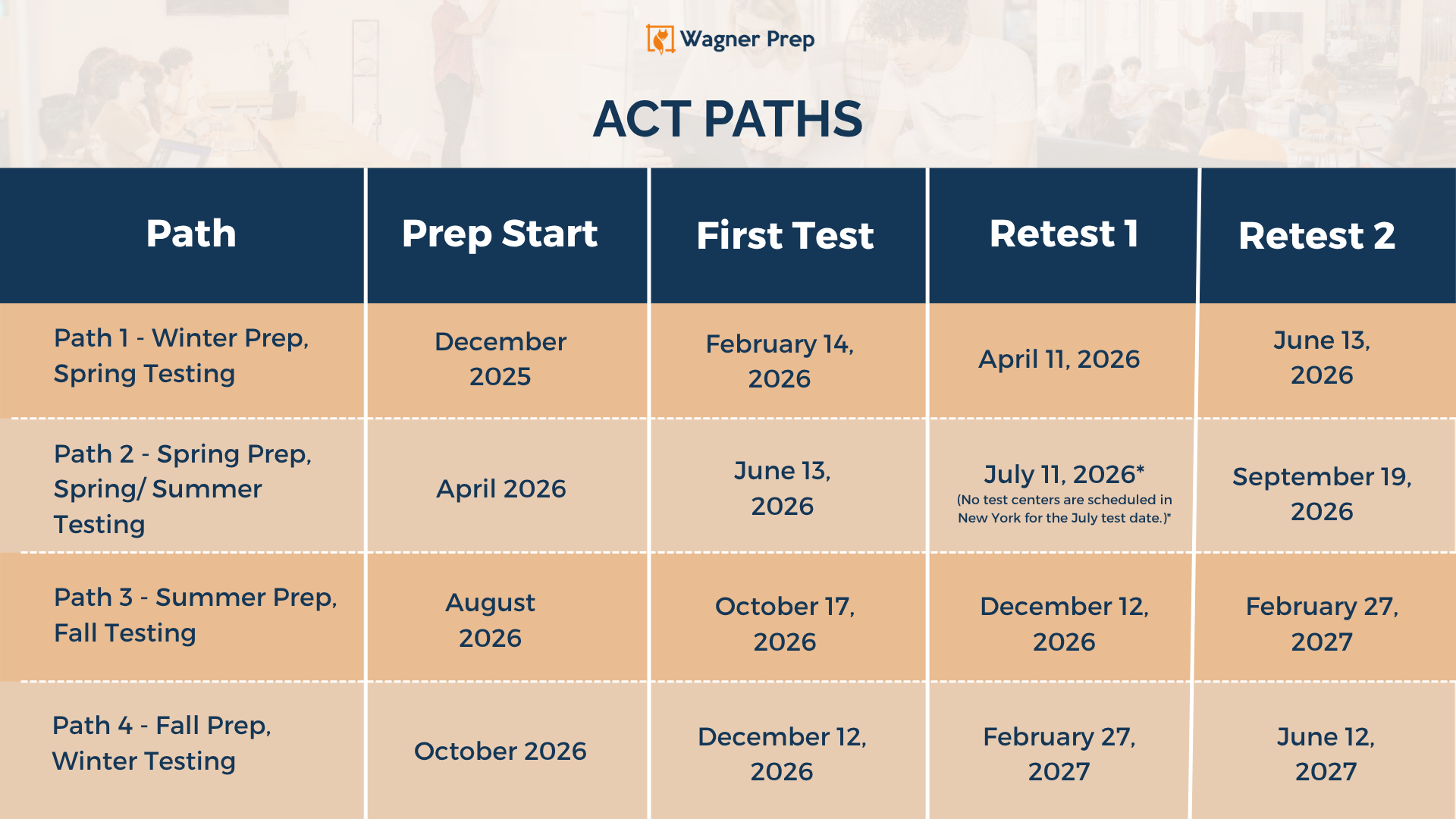
Download the full ACT Paths infographic to keep on hand as you plan your testing timeline
For a full breakdown of prep paths and how to decide which timeline fits your student, read our guide: wagnerprep.com/blog/junior-sat-act-prep-calendar
Course rigor matters more than you might think
Junior year is the most important transcript year. Colleges want to see that students are challenging themselves, and the courses your student takes this year send a signal about whether they are ready for college-level work. That does not mean loading up on every AP available. It means taking the most rigorous courses your student can genuinely handle without burning out. One strong grade in a challenging class is worth more than a mediocre grade in the hardest course on the schedule.
Get on the road
Junior year is also the right time to get serious about campus visits, and the most valuable ones are not necessarily to your student's dream schools. They are to different types of schools. We encourage families to try and see at least one large public university, one mid-sized private, one small liberal arts college, and one technical school, ideally in the same regional trip. The comparison is the whole point. A student who has stood on a large state campus and a small liberal arts quad has a much clearer sense of what they actually want than one who has only seen schools that look similar to each other.
Two trips that work well for NYC-area families:
Upstate NY tour: SUNY Buffalo (large public), University of Rochester (mid-sized private), Colgate (small liberal arts), RIT (tech/STEM)
Boston tour: UMass Amherst (large public), Boston College (mid-sized private), Wellesley (small liberal arts), MIT or WPI (tech/STEM)
For Northeast families, February break is a practical window. High schools are closed but most campuses are fully in session, which means your student gets to see what the place actually feels like with students on it.
Start building the list
You do not need a finalized college list by the end of junior year, but you do need a working picture. Start thinking about the categories that matter to your student: size, location, campus environment, academic programs, distance from home. Visit a few schools. Have the financial conversations early. The goal is to arrive at senior summer with enough clarity to move quickly, not to spend August starting from scratch.
Before you leave junior year, here is what you want to have in place:
At least one official SAT or ACT score on the books
A testing plan that maps out your remaining attempts before senior fall
A few campus visits completed, ideally across different types of schools
A rough sense of what your student wants: size, location, programs, campus feel
Recommendation letters requested from junior year teachers before school ends
An honest conversation with your family about finances, distance, and what a realistic college list looks like
None of it needs to be perfect. It just needs to be started.
Rising Seniors
This is where the timeline stops being abstract and starts being scheduled calendar reminders. The summer between junior and senior year is where students have to do the most work, and the families that come through this well are the ones who start that summer with a plan already in place.
We tell students you are going to give away some of this summer, and you will get it back next summer. Senior summer, after decisions are in, has no homework, no summer reading, and a lot of celebration ahead. The tradeoff is worth it.
Below is the full month-by-month breakdown, from spring of junior year through the final decisions in winter. Click through each slide to see what needs to happen and when.
The essay workload is larger than most families expect
Once you have seen the monthly timeline, the thing that tends to surprise families most is the volume of writing involved. Most parents applied to a handful of schools and wrote one essay, maybe two. The process looks very different today.
Students applying to 12 to 15 schools write an average of 27 essays. Some are short, 50 to 150 words. Some are as long as 650. None of them are throwaways. Each one requires research, a specific angle, and real writing time.
The Common App personal statement is the one that goes to every school, and it is also the one students procrastinate on most. Not because they are not taking it seriously, but because they are taking it too seriously. The weight of it makes it hard to start. Our internal target for every student we work with is a strong first draft completed by July 15, before senior year begins and before the supplemental essays start stacking up.
Those supplementals are what most families underestimate. A school like UW-Madison wants 650 words on why you want to attend and why you chose your major. Cornell wants 300 words on a community that shaped you. The University of Georgia asks for a book that had a serious impact on you. Each prompt is different, each requires its own angle, and if you are applying to a competitive program like the Ross School of Business at Michigan, you may be looking at four separate supplemental essays for that one school alone.
You often will not know what the supplementals are until you start the application in the fall. This is why front-loading the personal statement in June and July is not optional. The supplements need September and October to be written properly, and they do not get it if the Common App essay is still in draft form in September.
One more thing worth knowing about how we approach the personal statement: we never have students pick a prompt first and write to it. Instead, we find the story the student wants to tell, and then choose the prompt that fits it best, because at the end of the day, every Common App prompt is about growth in some form. Start with the story, and the rest follows.
Building a college list that actually works
A college list is not just a ranking of schools your student heard about on TikTok. It is a strategic document. Done well, it balances ambition with realism, keeps financial options open, and gives your student real choices to make in the spring rather than a single outcome to hope for.
We typically work with students on a list of 12 to 15 schools, organized into reaches, targets, and likelies. Reaches are schools where your student is a competitive but not guaranteed applicant. Targets are schools where their profile is a strong match. Likelies are schools where acceptance is probable and your student would genuinely be happy to attend. That last part matters. A likely school should never feel like a consolation prize.
For families with merit aid in mind, the list does even more work. Many schools that are academic targets for strong students also offer significant scholarship money, sometimes $20,000 or more per year, to students they want to attract. Building the list with that in mind from the beginning, rather than as an afterthought, can change the financial outcome significantly.
The list also evolves. What starts as 20 schools in June will narrow through visits, research, and honest conversations about fit, cost, and distance. By August, when the Common App opens and supplemental essays become visible, the list should be tight enough that every school on it is worth the writing time it will require.
We build a custom tracking spreadsheet for every student we work with that organizes deadlines, acceptance rates, program notes, and aid information in one place. It is one of the free resources linked at the bottom of this post if you want a starting point for your own.
The framework behind all of this
The families that come through this process well are rarely the ones who started earliest. They are the ones who knew what to focus on at each stage and did not waste energy on the parts that did not matter yet.
Freshman and sophomore year is for exploring, building a strong transcript, and noticing where your student's genuine interests are starting to take shape. Junior year is for evaluating options and making decisions: testing, visits, course rigor, and the early outlines of a college list. Senior year is for executing, and the students who arrive at that phase with the groundwork already laid find it significantly more manageable than the ones who are starting from scratch in August.
If there is one thing we hear most consistently from families wrapping up the senior year process, it is that they wish they had started the conversations earlier. Not the applications, not the test prep, just the conversations. About what your student actually wants. About what your family can realistically afford. About what kind of college experience would genuinely fit this particular kid.
Those conversations do not require a college advisor. They just require time, and the earlier you start having them, the better positioned your family will be when decisions need to be made and executed.
Free resources to help you get started
College List Tracker: our custom Google Sheet, pre-loaded with school data.
The College Search Guide: a PDF overview of the process from our team.
Common App Essay Prompts for 2026-2027: https://www.commonapp.org/apply/essay-prompts
Johns Hopkins Essays That Worked: apply.jhu.edu/college-planning-guide/essays-that-worked
Write Your Way In by Rachel Toor: a short, readable book on the college essay process. Available on Amazon.
Free Monthly Practice SAT: Wagner Prep hosts a free digital practice test every month. Register at wagnerprep.com/practice-test.
Ready to talk through your student's specific situation?
This timeline gives you the framework. What it cannot do is tell you which testing lane fits your student's schedule, whether early decision makes sense for your family, or how to build a list that balances reach and safety without feeling like a compromise.
That is the conversation we have every day. Reach out to our team directly when you are ready for it.
